Samantha Humphreys

Art, Photography, Inspiration & Education

Tag: painting

10 Essential Items for a Miniature Art Studio

I have been finding ‘stuff’ that I think would be great to add to my miniature studio and just kind of dumping it in. It’s an ongoing therapeutic task, as each item carries its unique charm and potential and fits nicely into its new role as beautiful object, subject, muse and inspiration. I have created small paintbrushes, miniature canvases and tiny easels that are perfect for bringing this project to life. Already, it is shaping up to be a convincing replica of a working art studio, reflecting the creativity and passion that artists nurture in their spaces. The benefit of an art studio, though, in all honesty, is that finding ‘stuff’ is easy as anything, and everything could be useful to an artist. From scraps of paper to bits of wood, even crumpled paper and debris. Every little thing can spark inspiration and lead to new ideas. This process of collecting and making has not only filled the studio but has also reignited my understanding of what truly makes a creative environment thrive. I have started compiling a list of items that an artist cannot live without, based on the true life story of , well, me! I have limited myself to a list of ten, with a little cheating of course because, really, ten? A ridiculous notion.

  1. Pencils. Obvious, but I mean many, many pencils. Pencils made of wood, made with charcoal. Pencils with colour, pencils that are mechanical and pencils that are not pencils at all, but are rubbers. Pencils in various shapes, some round, some hexagonal, and others triangular for ergonomic grip. Pencils of different grades for various artistic expressions, ranging from soft buttery lines to crisp, sharp marks. For writing, sketching, or colouring, a collection of pencils is essential for any creative. Watercolour pencils and a decent set of coloured pencils are seriously underestimated by many aspiring student artist.
  2. Brushes. Another obvious one, to be fair, the list in its entirety is obvious to most. Brushes of all sizes, watercolour brushes, acrylic brushes and some brushes in between that are used for everything from delicate work to broader strokes. Brushes for painting on walls, brushes for brushing away rubber debris, and also, boringly, a brush to sweep the floor and a brush that lives with a dustpan. In addition, there are specialised brushes for specific techniques: fan, round, flat, rigger and a chap called Filbert.
  3. Surfaces to paint on (paper, cardboard etc.). This is a never-ending possibility, I can’t begin to tell you how many surfaces I like to use. I have the usual card/paper/speciality paper, which comes in various textures and thicknesses. I also have old bits of flooring, perfect for a painting that will be free standing or unframed. Old bits of plasterboard from an old wall, providing an interesting texture to an acrylic painting and packs of playing cards, which add a playful element to small projects, along with old books whose pages can be transformed into unique canvases.
  4. Vessels. Jars, old cups, and vases are all required for storing things in so you can see them clearly. They serve not only as practical items but also as still life subjects, showcasing the beauty of everyday objects and their forms while holding water, enhancing the aesthetic of any space. Because, well it isn’t just about the practicalities, it has to look good. I like my storage to be pleasing to the eye too, and as my space is for therapeutic art sessions, I need it to be a calming environment and not too cluttered.
  5. Shelves. As many as possible, ones that can be moved about are the best! There can never be too many shelves in an art studio!
  6. Drying area/rack. As space saving as possible, I utilize my wall mounted rack, which is incredibly efficient and helps keep everything organized. I use it not only to store paper stacks in an orderly fashion but also to ensure that my workspace remains clutter-free. Furthermore, I peg my artwork up on a line to dry, allowing it to air out properly while maximizing the use of vertical space in my studio.
  7. Washing line. See above.
  8. Art media. This is getting exciting now, ooooh there are so many possibilities. Acrylic paint, watercolour, printing inks, powder paint, marker pens, felt pens, paint pens, watercolour crayons, watercolour pens…coloured pencils, oil pastels, soft pastels, charcoal, pastels in various forms, mixed media supplies, ink pads, gel pens, paintbrushes of every shape and size…there is a point where you will panic and wonder whether the art studio, undeniably the biggest pencil case you’ve ever had, is in fact large enough to house all the wonderful art supplies you have acquired over the years. The endless combinations of these materials, each capable of sparking creativity and inspiration, knowing where they all are is such a joy, leading to an overwhelming sense of potential that makes every artist’s heart race.
  9. Table. Essential for any workspace. I have a beautiful old table that my Mum got from a boot sale about forty years ago. Sanded and stained, I always longed to own it. It serves as a solid base for my practical work.
  10. Radio. For Popmaster, obviously.
Designing a Creative Space: My Arts Centre Vision

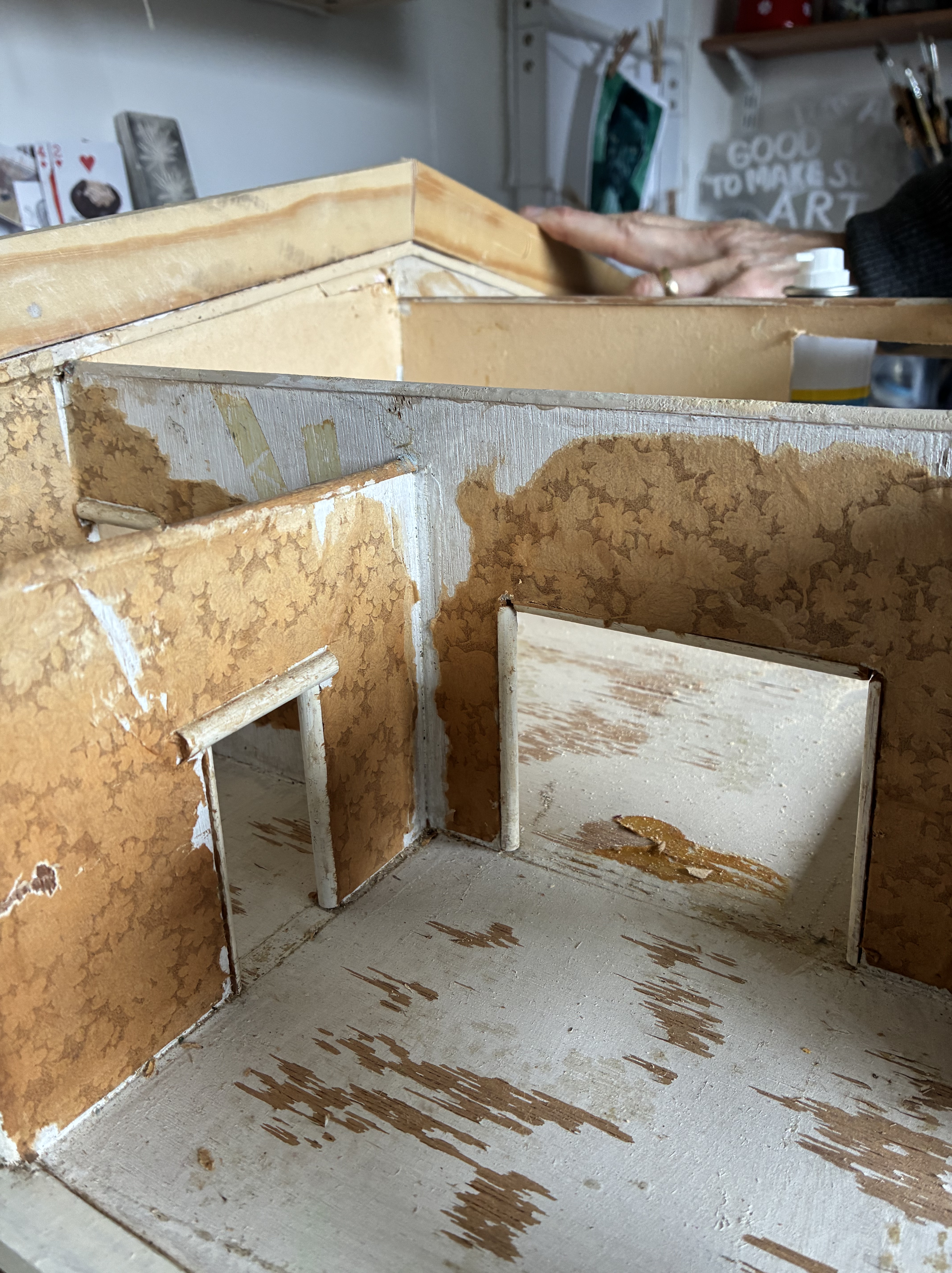
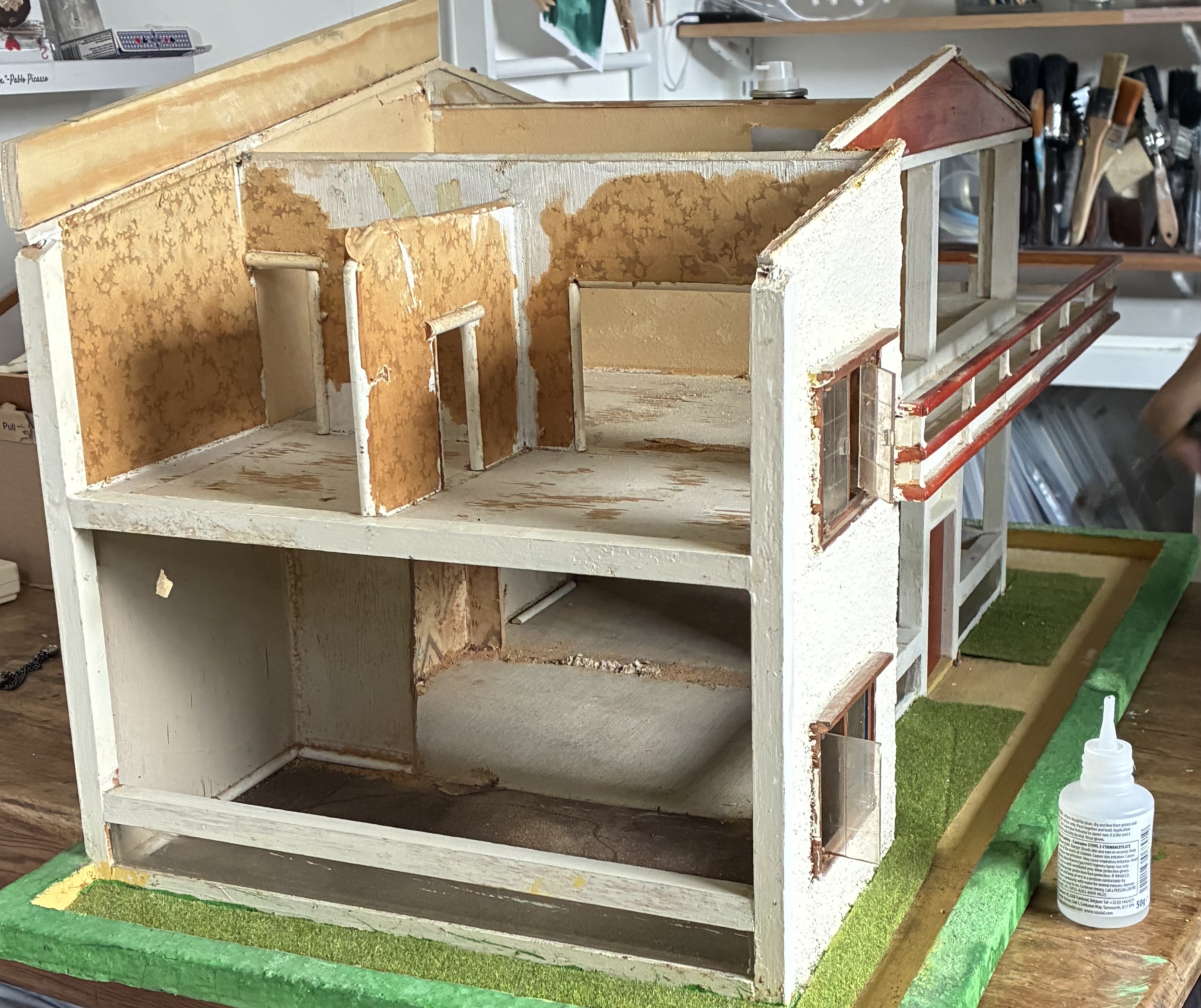
I have had the most productive of days. First of all, I bagged up a load of cardboard for recycling that I have been meaning to do for months. With the recycling sorted, I set about making some important decisions on my soon-to-be miniature arts centre.

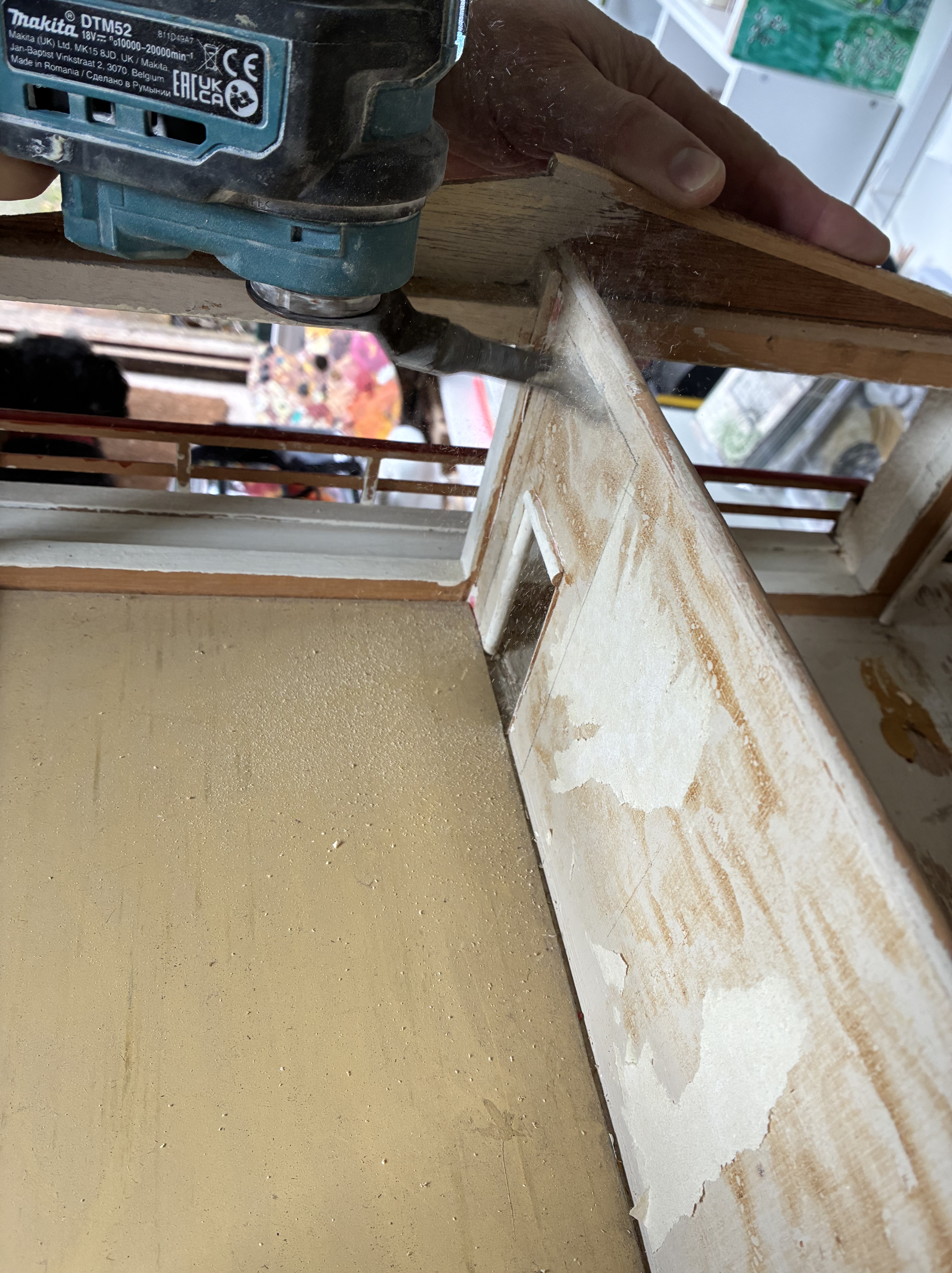
I enlisted the help of my husband, as he is the one with the know-how when it comes to using the tools needed for the job, and, come to think of it, he is also the one with the tools themselves!

The roof came off in two pieces, but that was to be expected. Removing it revealed a whole new world of possibilities inside. Once it was off, I started to wonder how I could raise the roof. My Gaga had made a pitched roof to make the house more special, which adds character and charm, so I wanted to retain that essence; yet, I also needed the ceilings upstairs to be higher to look more authentic. I want this miniature arts centre to be as close to 12th scale as possible, and it will be, as long as my inhabitants are no taller than the average height!

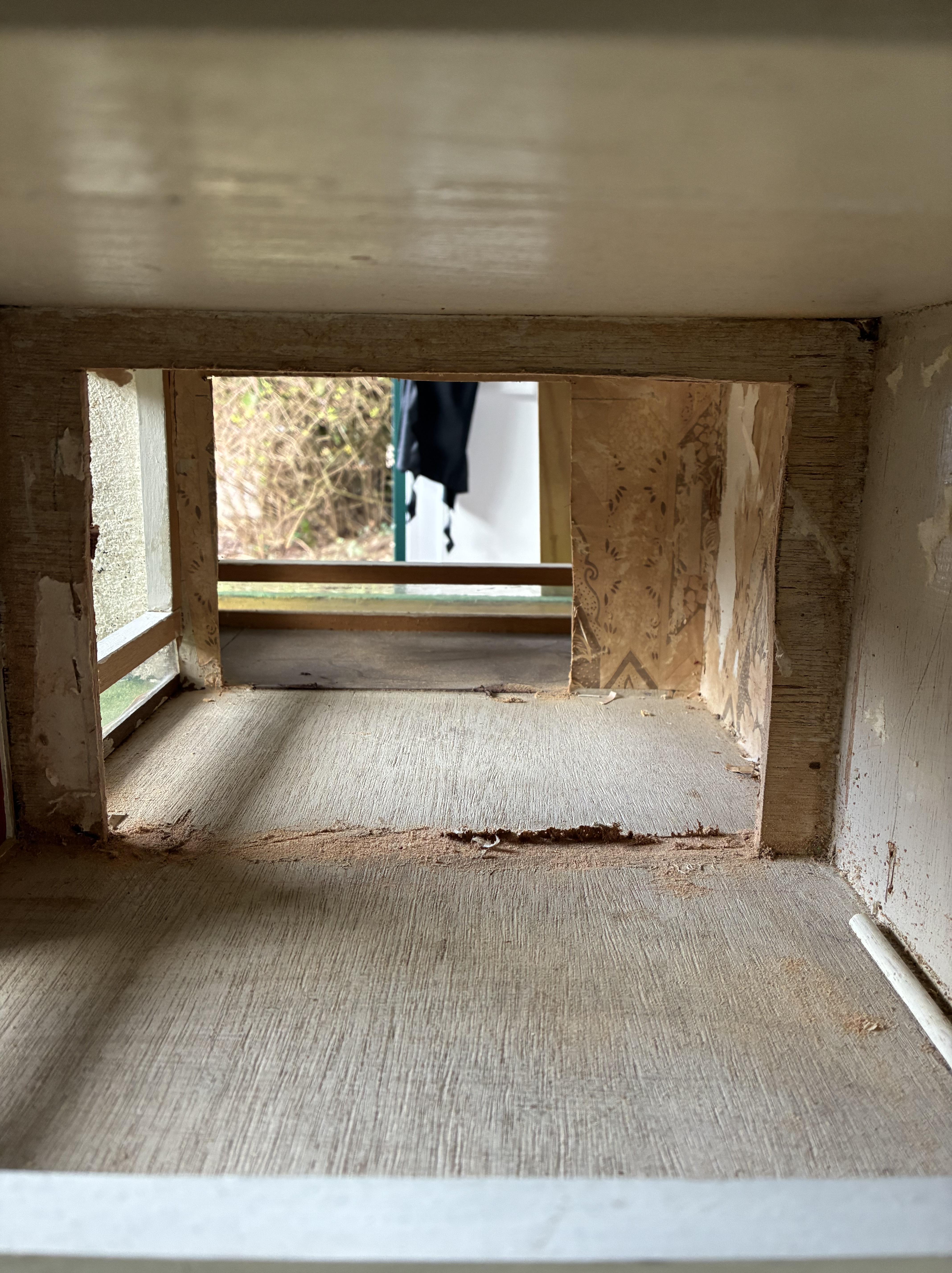
The doors were all far too small, which led me to opt for a more open-plan design. This choice is not only practical but also more suited to an art space, allowing for a flow of creativity that echoes the environment I envision. Where doors are necessary, such as for the toilet, I decided it will be a non-opening door, as I want to retain the internal walls as much as I can. This kind of design strategy is integral to the atmosphere I’m trying to create.

As I explained in my previous post, I want this project to represent what my life is now, and the person I have become. An arts centre or an art school is a little pipe dream of mine if I ever won the lottery. Like I said, a dream. Yet, I believe in nurturing dreams, and I decided I would surely need to include a teaching space in my building—after all, sharing creativity and skills is what an arts centre is all about.

I am so looking forward to taking this project forward; my mind is swirling with exciting ideas and also with a growing list of things I need to procure!

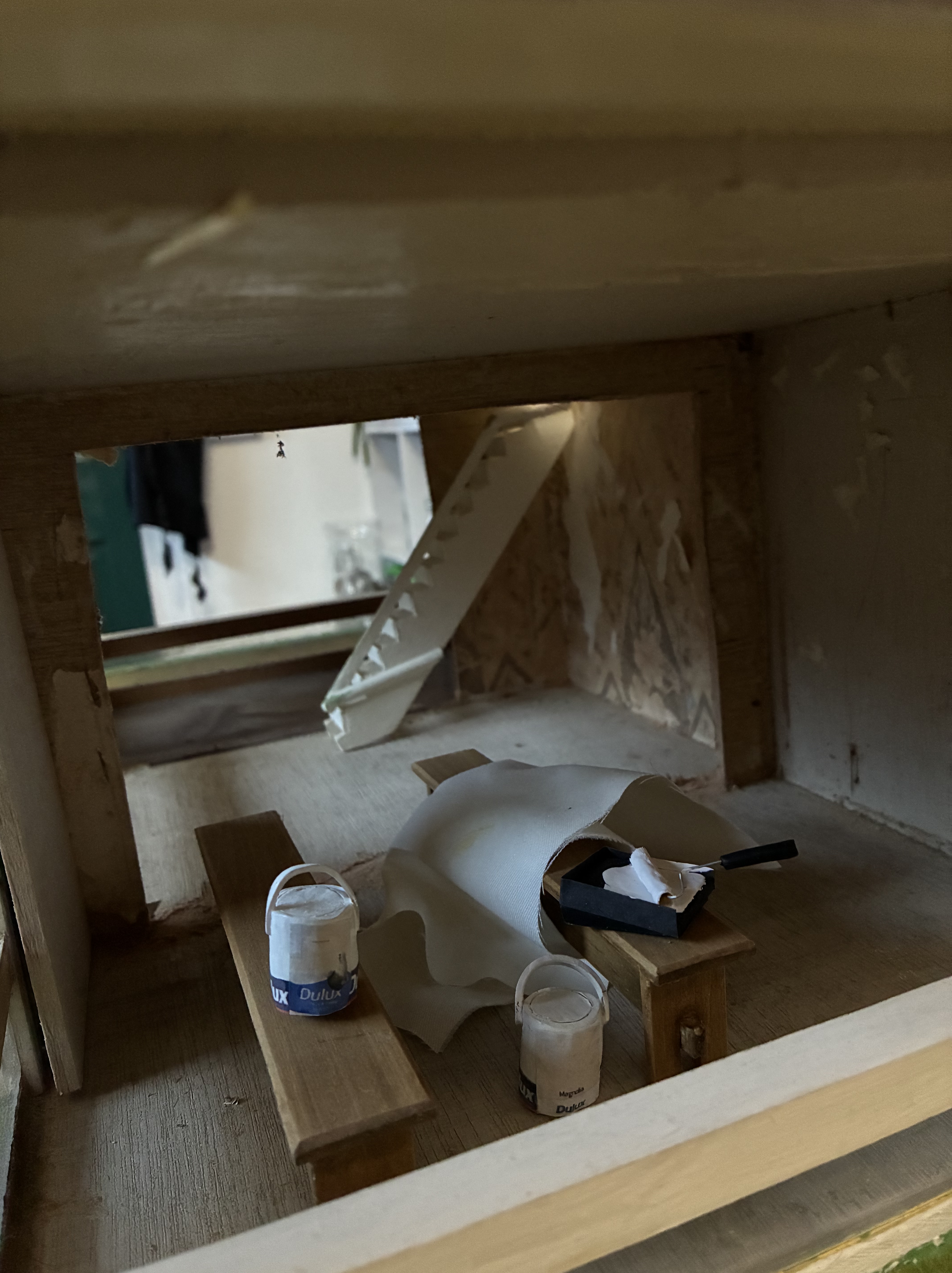
I have started to prepare the interior for decoration. The atmosphere is taking shape with paint pots, protective dust sheets, and a tray loaded with fresh white paint sitting in the gallery space, all ready for tomorrow’s ventures. The prospect of bringing colour, life and stories to the interior fills me with inspiration, motivating me to push through each phase of this project with the enthusiasm and passion I am filled with.

Impactful Art: Richard Long and Lucien Freud Uncovered

So as my birthday treat to myself, I took myself off to London for a day filled with art, art, and more art. First, I went to Tate Modern, my favourite art gallery because there is so much variety, so much to see, hear, and explore. The moment I stepped inside, I walked through the expansive galleries, as always, I look in awe at the incredible installations that seemed to challenge the very notion of art itself. As I ventured through the exhibits, I found myself lost in thoughts about the artists’ intentions and the stories behind their works, which made the experience even more enriching and memorable.

What I love about the Tate is that each time I look at art that I have already seen once or more times before, I see or experience something different.

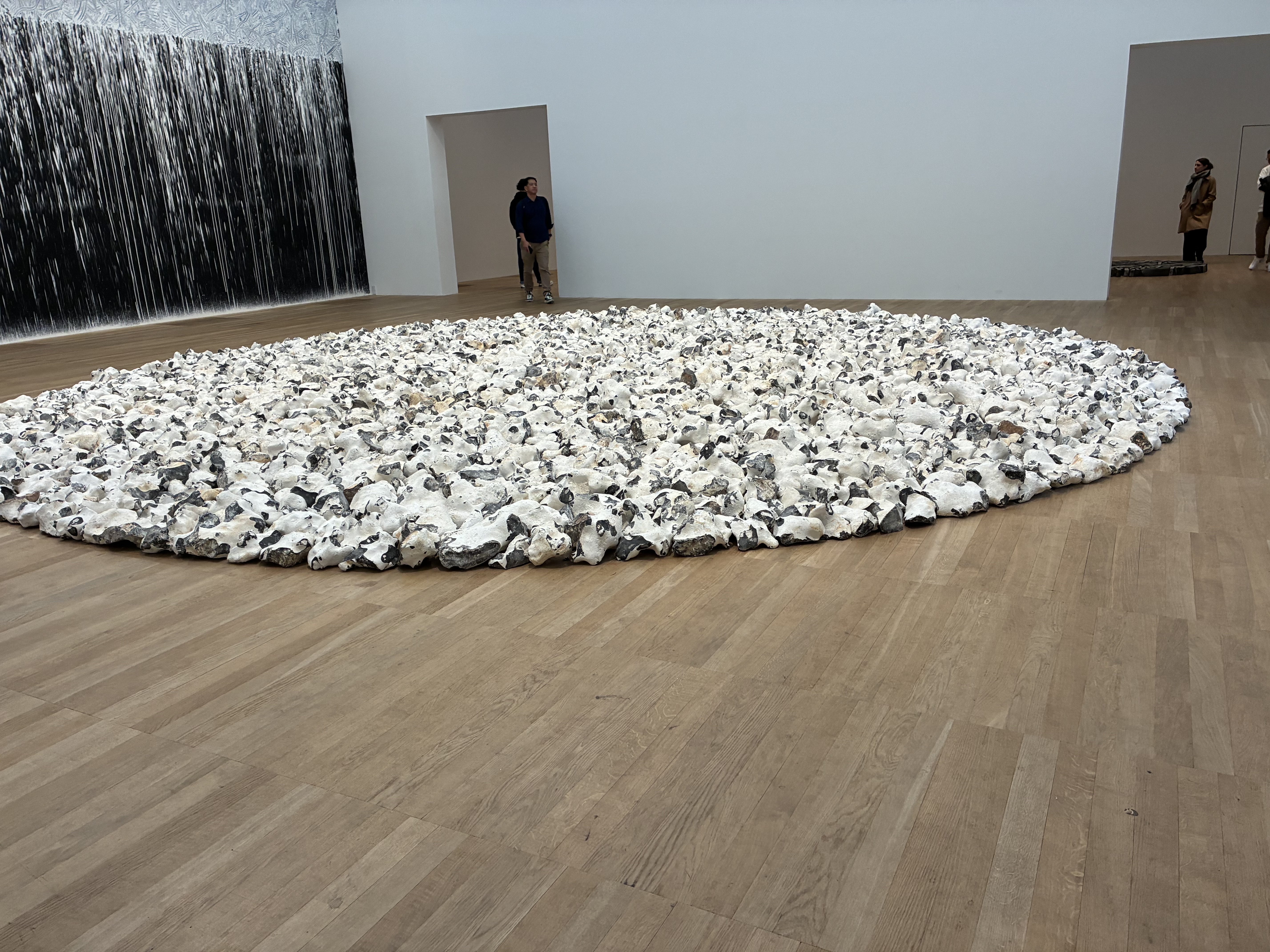
I went into the room showing work by Richard Long. I have long admired his site specific works documenting the interactions between humans and the environment such as A Line Made by Walking (1967). I was drawn this time to works made by creating circles, something that recurs in my own practice as does work borne of my walking routine.

Norfolk Flint Circle (1990) Richard Long

The installation Norfolk Flint Circle (1990) is interesting not only due to the satisfying perfection of a circle formed of meticulously placed flint but how bringing inside objects that are meant for the outside instantly shifts the importance of them. Placed outside as are some of the artists other circular structures, the flint pieces are part of the site, belonging to the earth, the surroundings. The decision to bring those elements inside, spending time and money transporting them and carefully arranging them in a large indoor room meant just for them, makes it almost an act of worship.
Indeed, nature is forceful and should be respected which I why I felt that this artwork was incredibly impactful.

Then I walked to The National Portrait Gallery to see the Lucien Freud exhibition, it was a gorgeous day still. I walked through St James Park and noticed a little cottage with an allotment, London is so strange with these quirky happenings in the most unlikely places. On the lake, there were black swans, I’ve never seen those before either. The National Portrait Gallery is a stark contrast to the Tate Modern. The experience is a formal one, which befits the formal nature of the artworks on show.

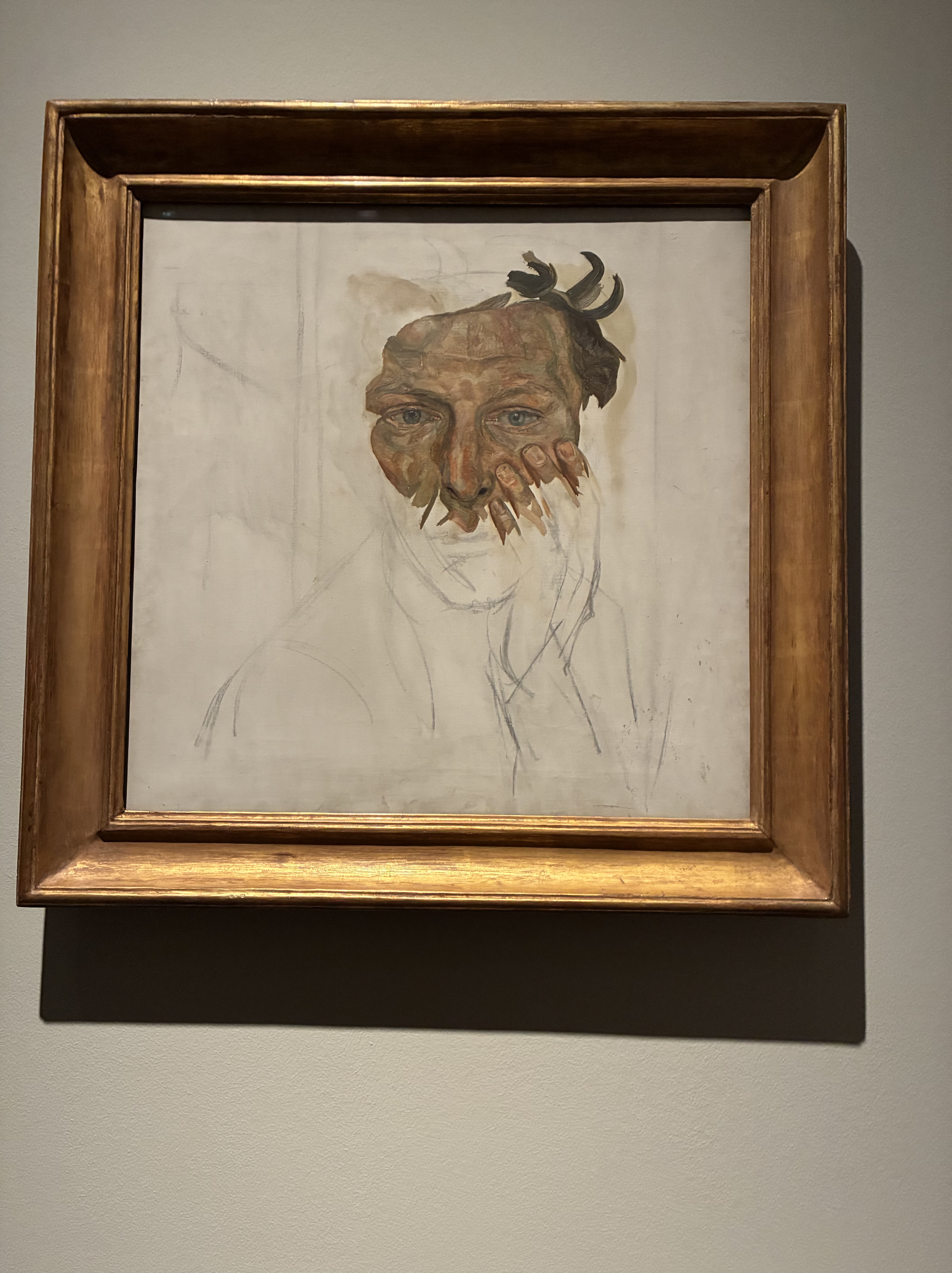
Self Portrait Fragment (1956) Lucien Freud

Freud is an artist that I have neither studied or taught in detail but that made it all the more enjoyable as I was viewing with fresh eyes. As always I was drawn to the organic materials that were either unfinished or considered a draught or preliminary work. I am more often than not more excited by this matter than I am by final outcomes and framed work. There is something about seeing up close the process of a wonderfully executed painting emerging from a charcoal sketch that fills me with joy! it gives the painting life and is rich with texture and structure. I feel that it is my enthusiasm for these insights into the processes of other artists that has hd the most impact on my own artistic practices. It is why I like to leave sketch marks under my own paintings and why I like to see less than perfect finishes on my printmaking, the ‘printiness’ that a graphic designer would be brought to tears by.

As well as the many self portraits, Freud utilised the people around him as his subject matter, his wife Kitty Garman is tenderly portrayed in many paintings. What was particularly pleasing to see was the charming little collection of drawings from the artist as a child, typically childlike like the kind we find on every family household fridge.

“Every child is an artist. The problem is how to remain an artist once we grow up,” -Attributed to Pablo Picasso

Balancing Life with Art: Techniques for Clarity

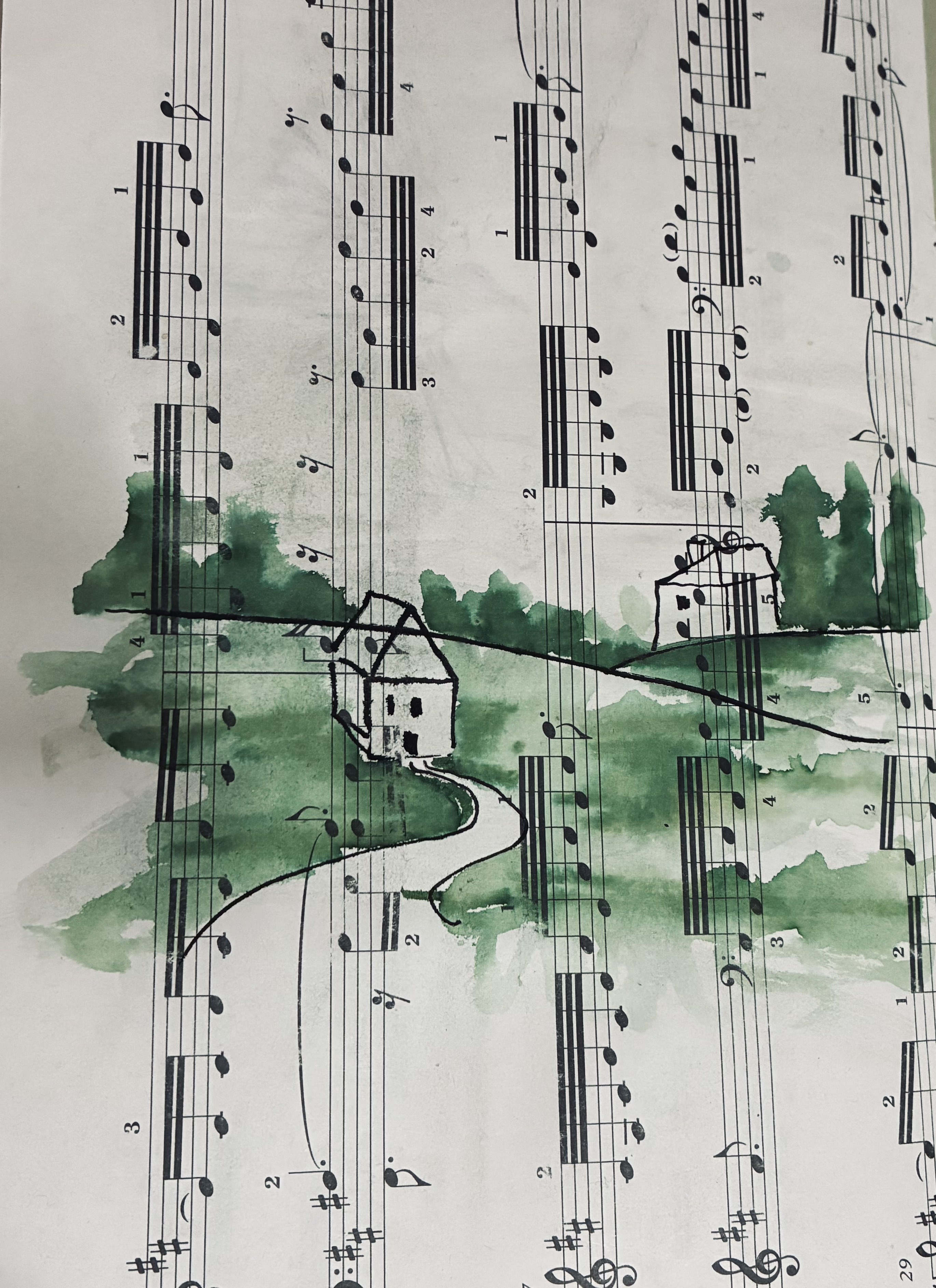
Grounding (2026) Watercolour on sheet music

I talked in my last post of restarting my year as it went a little awry mid January. I have reset my workload so it is a little more balanced and, I have started a cycle of decluttering both my home, art room and mind. Clearing my mind has not been something I have ever been able to achieve; when someone says “empty your mind,” what happens to me is that my brain panics, and every thought I have ever had starts whizzing around my head like a chaotic whirlwind.

However, I can use art as a means to focus. There are several exercises I have written for journaling that really work for me. By concentrating on the process, whether it’s the soft, flowing motions of watercolours or the crisp lines from a black fine liner (and I believe both mediums together create a marriage made in heaven!), I’ve found a way to channel that restless energy. It’s easy to block out the challenges of life by mark-making in those small, delicious moments of creativity. The more I practice these techniques, the easier it becomes for me to not ’empty my mind’ entirely but rather to recall the calming process of the art exercises. This recall can gently bring me back to the present moment, offering a reprieve from any noise that might be in my head.

Today was a bit different; the day was a little brighter and clearer, allowing me to enjoy a long walk, a luxury I haven’t had time to indulge in recently. Instead, I have been settling for several shorter walks, which are nice but don’t quite compare to the liberating feeling longer time out. It was refreshing to have the chance immerse myself in my audiobook.

In addition, I have been writing workshops that I am running soon and developing lessons to sell online. Of course, I’ve been immersing myself in making the art necessary to write these lessons, ensuring that I carve out these small mindful moments into each day. These activities not only fuel my creative spirit but also provide an avenue for self-exploration, allowing me to connect deeper with my artistic side. My commitment to maintaining balance and mindfulness is more than just a goal; it’s becoming an integral part of my life.

Mastering the Art of ‘Being’

Bocking Nature Reserve (2025)

I stopped to look at the tree I pass each day, the reason I stopped was that the skies behind it were divided into a a summer blue and a thundery grey. The sun was bright on and off so there was a moment when the complex system of nerve like branches were very defined. There was a yellow glow through the moss green that highlighted the creases in the bark, reminding me of wrinkles that have been caked in make up.

It is important to take care of yourself mentally as well as keeping physically fit. If you are anything like me, your mind is constantly in overdrive with worries, lists, texts messages and endless pulls on your time and attention. Sometimes, switching to aeroplane mode just for a short while will see you (or feel) reaping the benefits later on. This gives you the chance pay attention to what is around you whether that be an urban concrete landscape or land wrapped in fields, forests and streams. Either way, there will be air, sounds and sights of all sorts.

It is quite tricky to get into the habit of noticing what you see throughout your day. A way of training yourself to do this is the simple exercise of asking yourself: What three colours can I see? then, Choose one of those colours and find three shades of it; so using my photograph above a reference:

‘green/brown/blue!’

Then, as i’m unlikely to find three shades of blue and there are plenty of neutral hues around the centre of the image, I will look for three shades of ‘brown’ …if you are familiar with colours of a artist palette you might say:

Burnt umber/Raw Umber and Ochre or if not then simply Dark Brown/Light Brown/Beige

While you are doing this exercise, you will be unaware of anything that isn’t about those colours, even if it takes you less than a few minutes.

Life is too short for just coasting, doing what we think we should do and not saying things we want to say. Let loved ones know they are loved and also, just as importantly, celebrate that you are alive and take care of you!

That London

Private View (2025) Samantha Humphreys

Last week I attended the opening evening of London Art Fair, an event which I have only missed once in the last twelve years. As always, the Encounters section curated by Pryle Behrman was the highlight for me. This year, the work that caught my attention surprisingly for me were a series of paintings by Zbyněk Sedlecký from the Czech Republic who was represented by The Chemistry Gallery.

As my own creative practices embrace real life, I was drawn to the beautiful way this artist captures genuine moments that are not in any sense beautiful. Instead, he focuses on the less attractive ‘in between’ times of life. The paintings were mesmerising because they were interchangeable between being photorealistic and richly painterly and my mind seemed to switch between the detailed positioning of the body parts, the exactness of the light bouncing off the cutlery and the blurry fuzziness of the edges of the paintings. I just love them, they are wonderfully dramatic, theatrical and unexciting all at once. The collection is reminiscent structurally of the renaissance period with its grand still life compositions that celebrated wealth and status: though in contrast the artist is honouring the mundane, yet with the same traditional medium that you can almost still smell.

Nine minutes Past Eight

image

Nine Minutes Past Eight, (2019) Mixed media on plywood.

At nine minutes past eight just a few days ago I asked my friends a question ‘what does coffee mean to you?’ I received mainly one word answers immediately and I have presented them as miniature artworks, some inspired by the friend, others by the response given. As an artist I largely examine the boundaries between the digital and online presence and how it impacts our identity. Here I am focussing on how social media remains a useful tool for socialising and how Facebook, enables immediate social interaction bringing friends together within a digital environment, as coffee, in a physical space.

Painting

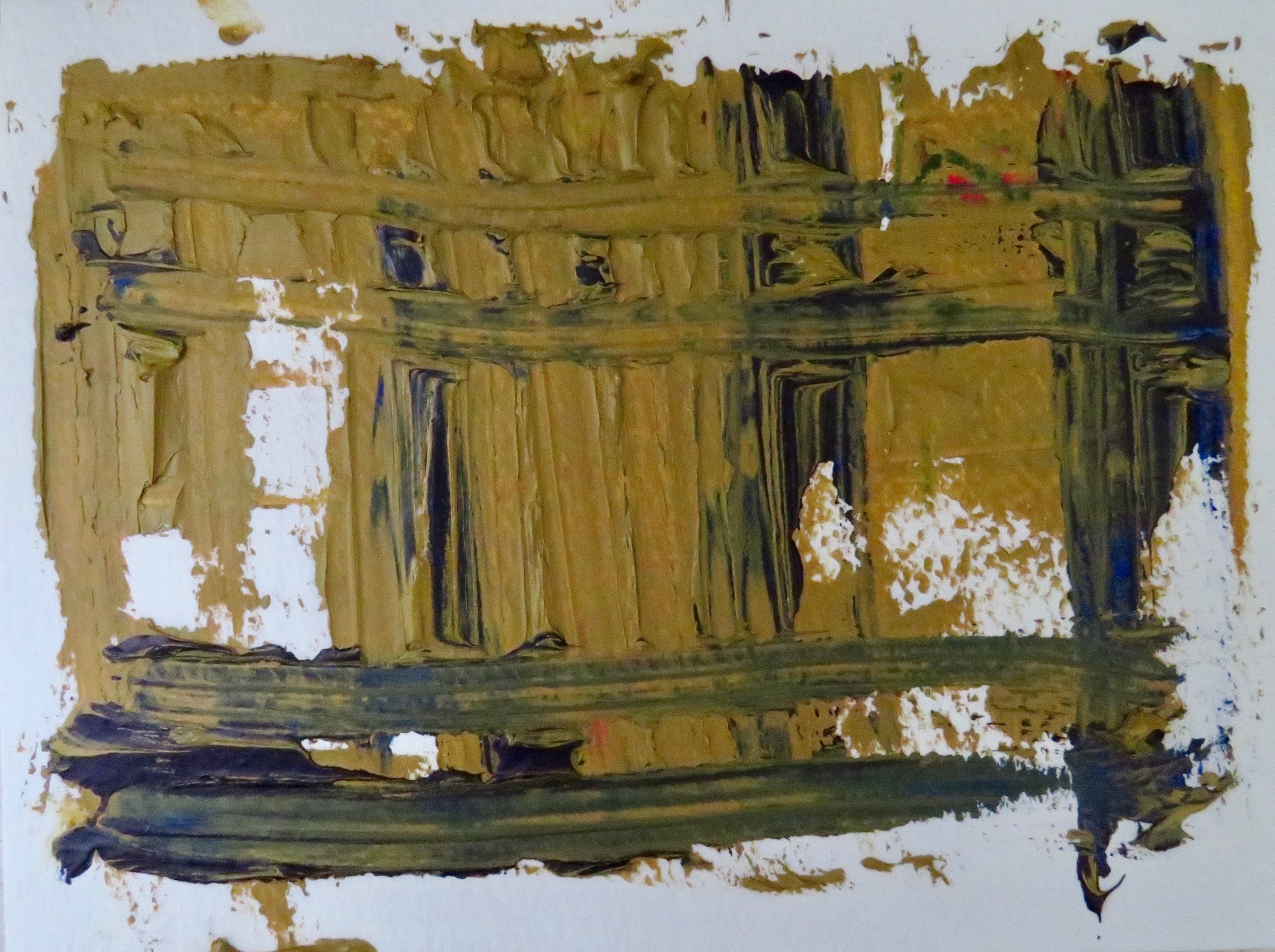
Yesterday at work, in our weekly student led drawing session the task was to apply paint to the surface without using any traditional methods of doing so. In other words, paintbrushes, palette knives etc ere not allowed. I rarely paint using a brush, my paintings tend to reflect how I’m feeling rather than have an intended visual outcome and applying with a brush doesn’t often fit in with this concept. It felt appropriate yesterday to use the discarded blister pack from my painkillers to push the paint around the surface with my fingers in the moulded bits.  I am pleased with the outcome, the drawing sessions are such an important part of our course as it forces us to keep creating and reflecting on our practice.

Untitled (2019) Oil, Water Colour and Acrylic on Water Colour Paper 105 × 148 mm

Untitled (2019) Oil, Water Colour and Acrylic on Water Colour Paper 105 × 148 mm

Untitled (2019) Oil, Water Colour and Acrylic on Water Colour Paper 105 × 148 mm

Untitled (2019) Oil, Water Colour and Acrylic on Water Colour Paper 105 × 148 mm

Untitled (2019) Oil, Water Colour and Acrylic on Water Colour Paper 105 × 148 mm